
St. Francois Parole vs Probation
Missouri places community supervision within the Department of Corrections Division of Probation and Parole, but the route into supervision matters. Probation usually comes from a court sentence and does not prove that the person ever entered a state prison. Parole follows a discretionary Missouri Parole Board decision to release a state prisoner before the maximum endpoint. Conditional release is different again: for an eligible term-of-years sentence, section 558.011 structures a portion of the sentence for community supervision.
| Supervision type | How it begins | Best verification | What it does not prove |
|---|---|---|---|
| Probation | A sentencing court orders community supervision, sometimes without prison. | MODOC active record plus the judgment and later docket entries in Case.net. | That the person was released from FCC, ERDCC, or any prison. |
| Parole | The Missouri Parole Board authorizes a state prison release under conditions. | MODOC status, assigned place, and the applicable Board or case record. | That the sentence has ended or the person is fully discharged. |
| Conditional release | A supervised part of an eligible sentence begins under section 558.011. | MODOC status and sentence-date records read with the court case. | That the release was unconditional or that every case is complete. |
| Discharge | The relevant sentence or supervision obligation ends. | A discharge record, completed sentence data, or court/Board order. | That every unrelated matter or hold also ended. |
A field assignment can therefore support a finding that someone has left prison and remains supervised. An institution assignment supports current prison placement. Neither label should be guessed from a Farmington address alone. St. Francois County contains two state prisons and a community supervision center, so similar place names can describe very different forms of custody.
Verify St. Francois Release Supervision
Start with identity, not a status word. Names and aliases can overlap, and one person may have several sentence rows. A MODOC offender number is the strongest starting key. When it is not known, compare the full name, birth information kept private, court cause number, offense, and location before treating a result as a match.
- Open the official MODOC Offender Search and note the “data current as of” time on its landing page.
- Search by offender number when possible. Otherwise use the live name fields and compare each candidate with stable facts.
- Read the exact supervision, location, and sentence labels. A field record supports active community supervision; it is not proof of discharge.
- Open Case.net and match the cause number. Review the judgment, probation terms, warrants, revocations, and discharge-related docket entries.
- Use the official Probation and Parole address listing to confirm the assigned office rather than assuming District 12 from residence.
- For a suitable specific question, contact the assigned officer or office. Use MODOC Constituent Services for general search and policy clarification.
The public MODOC search is limited to active offenders, including people on probation and parole. It expressly excludes discharged-offender information. Thus, no result cannot establish that a St. Francois County person was released, discharged, or never supervised. A fully discharged record may require a focused MODOC Sunshine request and the sentencing case. The broader St. Francois County release search explains how county jail records, court records, and state records answer different parts of that question.
Note: Keep a retrieval date and the exact agency labels because working status data can change after later corrections.
St. Francois District 12 Office
District 12 and the Farmington Community Supervision Center form the local MODOC contact point documented for St. Francois County. The office also serves Ste. Genevieve and Madison counties. It is a probation and parole office and community supervision center, not a jail, public warrant desk, or released-person roster. An address near the county jail does not make the two operations interchangeable.
District 12 / Farmington Community Supervision Center
1430 Doubet Road
Farmington, MO 63640
(573) 218-5006
Core hours: 8:00 a.m. to 5:00 p.m. Officer schedules and appointments may vary.
The published District 12 brochure says officers can use adjusted schedules and that an officer is available until 6:30 p.m. on at least one weekday each month. It also lists 1-888-869-3195 for an after-hours emergency. Because those arrangements can change, call the general office before relying on an old schedule. Do not use an emergency line for a routine public-record inquiry.
The center serves some people released from the Division of Adult Institutions and some existing supervisees who need more structure. The brochure names intake, Bridge Treatment aftercare, electronic or GPS monitoring, counseling, Pathway to Change, and GAP mentoring. These programs describe local supervision and reentry support. They do not show that every released St. Francois County prisoner reports to this building.
The official Farmington Community Supervision Center listing shows how MODOC identifies the local office.
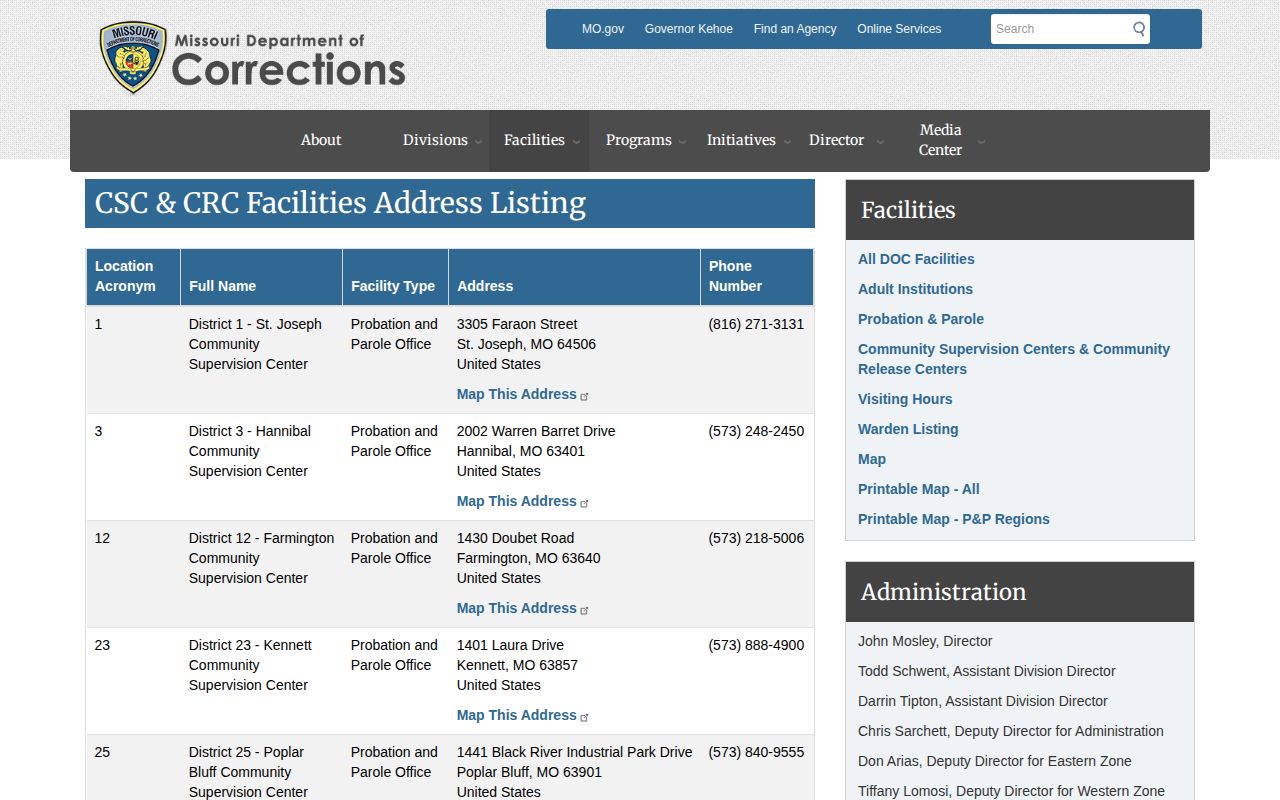
The listing is useful for contact and office verification, while the individual offender record remains the source for a particular assignment.
St. Francois Absconder Record Limits
An absconder notation means the supervising agency reports that a person has stopped complying with required contact or location duties. A warrant can follow, but the public must not turn a notation, rumor, or old post into a current legal conclusion. Confirm the exact status with MODOC and check Case.net for any public warrant, violation, or revocation entry tied to the correct case.
No official St. Francois County sheriff absconder list was found in the research sweep. A general warrants page, social post, or current jail roster is not a substitute for the statewide supervision record. Likewise, an absconder label does not erase the historical fact of release from prison. It describes what happened during supervision after that release.
If the person appears in the current county jail after an alleged violation, the jail record answers present physical custody. The MODOC record answers supervision status, and the court or Board record explains the legal action. Those sources may update at different times, so apparent conflict can reflect timing rather than error.
St. Francois Supervision Conditions
Conditions are person-specific. At a high level they can require reporting, approved residence or travel, participation in ordered programs, payment obligations, and compliance with electronic monitoring when imposed. Public search results do not expose every case-management detail, and Missouri law closes some offender information under section 217.075. A search result should not be stretched into a complete list of duties.
A violation allegation also does not automatically show the final outcome. The assigned officer, MODOC process, court, or Parole Board may determine whether a violation occurred and what response follows. Possible public clues include a Case.net docket entry, a new warrant, jail booking, revocation order, changed MODOC location, or later discharge. Read them in sequence.
MOVANS is designed for custody and court-event notification from participating agencies, not for a full log of supervision contacts. Since May 5, 2026, Missouri local-jail and court notices use SMS and email through MOVANS, while MODOC custody notifications go through the Office of Victim Services. Neither notification route replaces the assigned office for a supervision-status question.
St. Francois Supervision Office Detail
A local distinction prevents a common error: District 12 is a regional supervision operation with a community supervision center, and office proximity does not prove assignment. The official MODOC listings identify the Farmington site, but a specific person may be assigned elsewhere or may have an appointment schedule that differs from posted core hours.
Verification should therefore run in this order: establish the person’s active MODOC record, read whether the assignment is Field or Institution, match the cause number and sentence in Case.net, and only then contact the listed office. This sequence reduces misdirected calls and prevents a prison transfer, field assignment, or completed sentence row from being described as the wrong event.
The Missouri Parole Board page provides the Board rules and time-to-serve materials used for parole decisions.
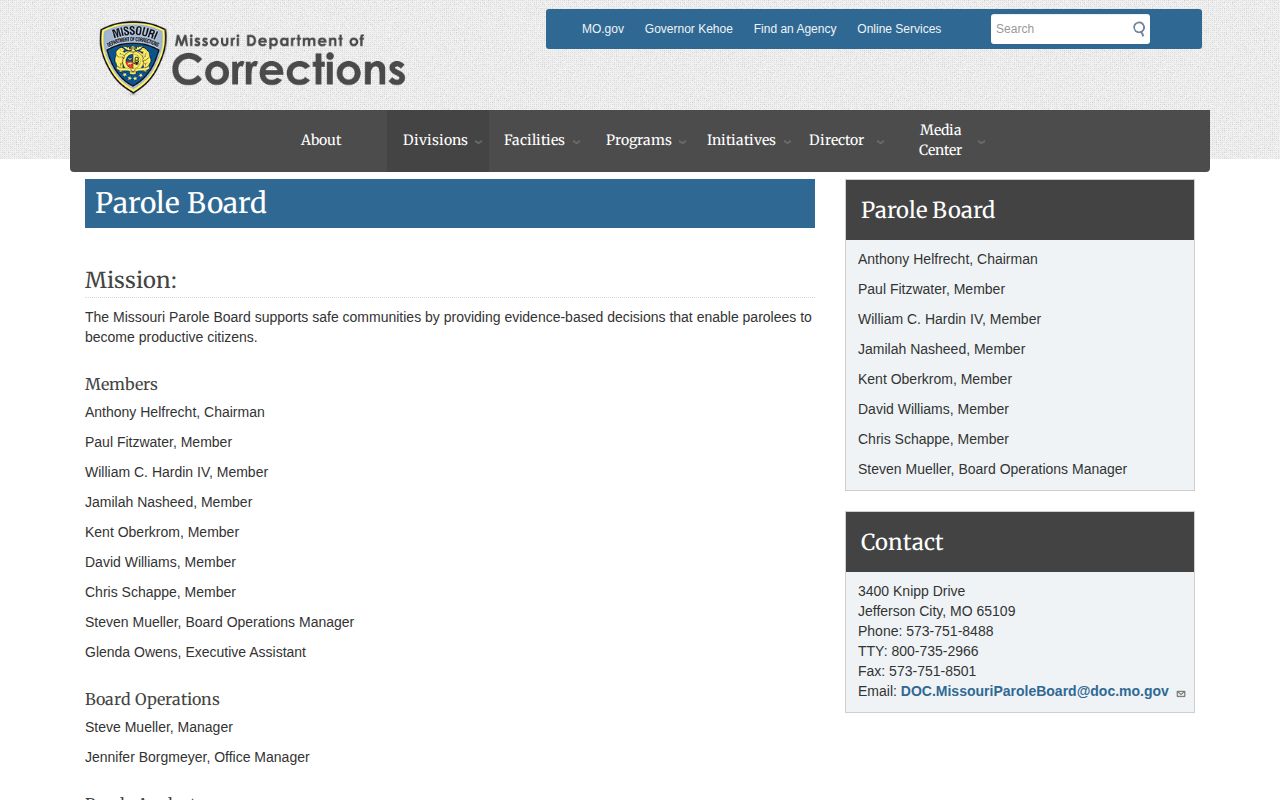
These materials explain the decision framework, but they are not a named-person hearing calendar or a public database of individual decisions.
St. Francois Supervision Discharge
Discharge is the endpoint to verify when the question is whether legal supervision has ended. It differs from release from prison, a move to field supervision, or completion of one sentence row. MODOC’s glossary treats parole, conditional release, probation, discharge, and death as events that can close an individual confinement record, yet the public Offender Search does not show discharged offenders.
Section 217.703 provides earned compliance credits for certain eligible people already under community supervision. Qualifying compliance can shorten the time to final discharge. Absconders do not earn those credits. MODOC recalculates remaining months at least twice yearly and gives notice as discharge approaches. This credit applies to supervision and must not be described as a way to leave the St. Francois County Jail or a state prison early.
A reliable discharge check can require the final court or Board order, all sentence rows for the DOC ID, and a MODOC discharge-file request. A completed flag can apply to one row rather than all concurrent or consecutive matters. Match each row to its Case.net cause number. If the public search returns nothing, request releasable discharge data through the MODOC Sunshine custodian instead of declaring the person discharged.
Note: MODOC probation and parole case folders have a long retention schedule, but retention does not guarantee public online display.